CuriSnap marks and hallmarks field guide
Antique marks and hallmarks: a practical identification guide
Identify an antique mark by recording the complete mark group, its location and the whole object before searching a symbol or name. A hallmark may encode metal fineness and an assay office; a factory mark, signature or label follows a different system. No single mark proves that an object is genuine.
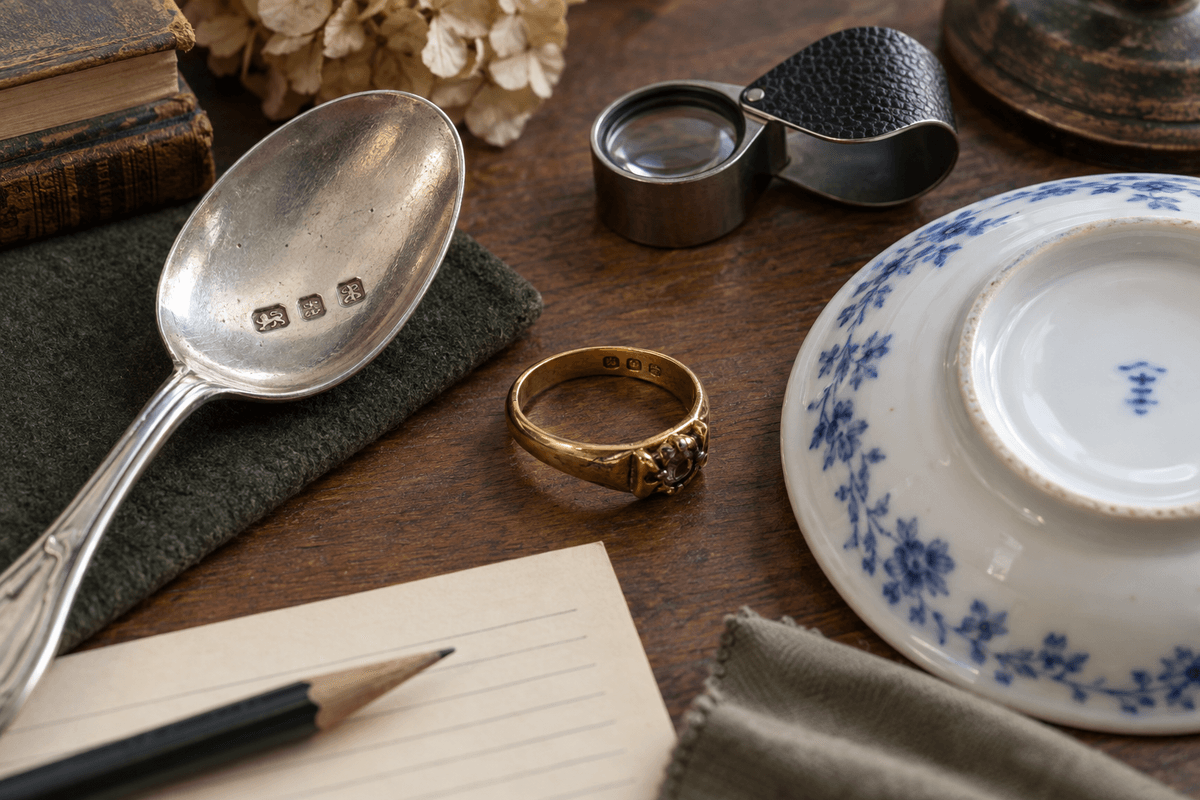
What kind of mark is on the object?
Separate regulated hallmarks from trademarks, model numbers, pattern names, registration marks, handwritten signatures and ownership inscriptions. The category determines which reference catalogue is relevant.
What should be recorded before searching?
Photograph the entire object first, then the complete mark group, then a sharp close-up from a second light angle. Record dimensions separately. Preserve the original file; do not polish, scrape or retouch a mark to make it easier to read.
| Evidence | What to record | Research limit |
|---|---|---|
| Mark type | Useful evidence | Does not prove |
| UK hallmark | Sponsor, fineness and assay-office components | That every other mark is genuine |
| Factory or maker mark | A candidate manufacturer or workshop | Exact production date by itself |
| Signature or label | A name or ownership trail to research | Authorship without comparison and provenance |
How should two mark references be compared?
Match the complete sequence, outline shapes, orientation and object context. Record conflicts as carefully as matches. A partial resemblance is a candidate, not an attribution.
What can an antique mark prove?
A photographed mark is evidence to research, not a certificate. A mark alone cannot prove authenticity, exact age, maker attribution, precious-metal content, condition or market value. Compare the complete object with documented records and obtain an in-person test when the decision depends on material or authenticity.
What is the safest next step?
Use the object category links below to find the correct reference system. If a purchase depends on precious-metal content or authenticity, request written seller evidence and an appropriate independent examination.
Primary references
- British Hallmarking Council: Hallmarking practical guidance
- The Metropolitan Museum of Art: Sèvres porcelain makers and marks
- Smithsonian American Art Museum: Researching your art
References support the stated systems and documented examples. They do not endorse CuriSnap or authenticate a reader’s object.
Frequently asked questions
Can antique marks and hallmarks authenticate an object?
No. A photograph and reference comparison can narrow a research question, but authentication and material testing require appropriate examination of the object.
What photograph should I take first?
Take one sharp photograph of the entire object, followed by the complete mark group and a close-up from a second light angle.