 CuriSnap
A matching mark needs independent support. V&A records copied Chelsea anchor and Meissen crossed-swords marks. Resemblance to a factory mark does not establish an authentic factory product.
CuriSnap · PHOTO RESEARCH
Read more than the mark.Look at the whole ceramic.
Compare bowls with the same inscription but different museum dates, then examine repairs on a plate underside.
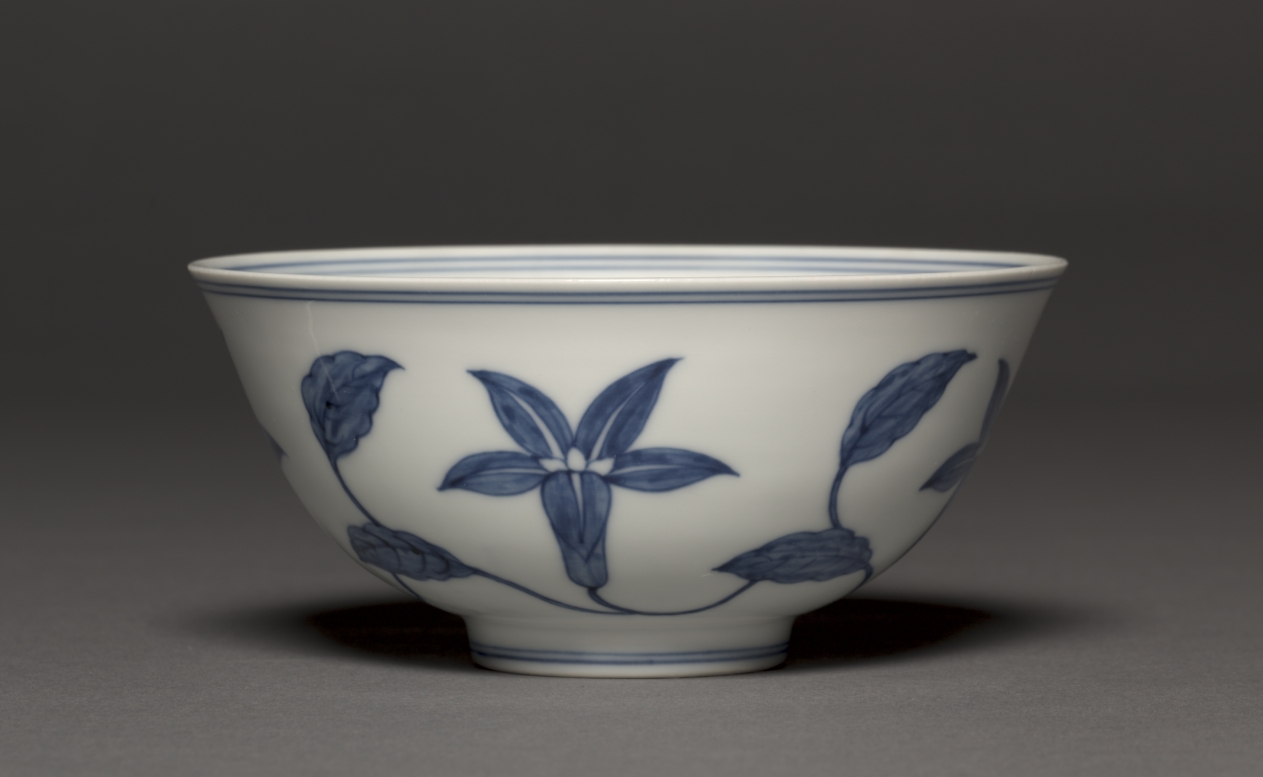
REAL REFERENCE PHOTOGRAPHBowl with lily scrolls
Two bowls. The same reign mark. Different dates.
Would a Chenghua inscription send you straight to Chenghua prices? Compare these two documented museum objects first.
Bowl with lily scrolls
Notice the blue floral scroll, double line at the lip and foot. The museum catalogs this as a Chenghua-period bowl with a Chenghua mark. The inscription comes from the catalog, not this front-view photograph.
Cleveland Museum of Art · 1967.64 · CC0Bowl with Xiwangmu and attendants
The photo shows painted figures and a foot. Its catalog also records a Chenghua inscription, yet dates the bowl to the Kangxi period. A reign inscription and production period can differ.
Cleveland Museum of Art · 1964.218.1 · CC0Turn one assumption into three questions
1. What does the inscription say? Transcription. 2. Which cataloged objects share the form, decoration and technique? Comparison. 3. What independent evidence supports the date? Dating. The color difference is not a universal dating rule; these dates are museum attributions.
Why turn over an apparently complete piece?
Condition is more useful as a record of specific features than a single adjective. Photograph losses, cracks, joins and repair areas before deciding whether market records are comparable.
Metal staples on a plate underside
Metal staples cross joins on the right while a blue mark remains visible on the left. A crop of the mark would hide the repair. Record its location and corresponding face; a photo does not establish structural stability.
Rodolph R. de Salis / Hohum · CC BY-SA 3.0 · LicenseRim loss and visible joins
Large sections are missing from the rim and lines cross the body. Record missing material separately from cracks or joins rather than calling everything a small chip. Keep these differences explicit when comparing intact pieces.
Nico Inslegers / Raakvlak · CC BY-SA 4.0 · LicenseWhat does a useful condition note look like?
Example: “Multiple metal staples cross joins on the right underside. The matching face has not been photographed. Fills and overpainting have not been checked.” This separates what was observed from what remains unknown. Do not clean, dismantle or scrape the surface to test a guess.
A price tag is not the total you pay
Separate the sale price, buyer’s premium and shipping. Change the hypothetical numbers below. This is arithmetic, not an auction quote or object valuation.
Formula: hammer price × (1 + premium rate) + shipping. Tax, insurance and payment fees are excluded. Actual transactions follow the relevant seller’s terms.
Both bowls have Chenghua inscriptions. What follows?
What remains uncertain in a base-mark photo?
| Visible clue | Supports | Does not establish | Next check |
|---|---|---|---|
| A period or factory inscription | The identity claimed by the mark | Actual production date or factory | Compare the whole form, decoration and cataloged objects |
| Resemblance to a reference mark | A candidate to investigate | Authenticity or the same production period | Record strokes, color, location and the surrounding foot |
| Crackled glaze | A visible surface condition | A date based on crackle alone | Document cracks and damage without treating appearance as dating proof |
WORKED SCENARIO · NOT A VALUATION
Why is a readable teapot mark still not a valuation?
Reading a mark does not establish the identity, completeness or repair history of the whole object. With only a base view, the useful result is a list of missing evidence, not the price of an expensive piece with a similar mark.
Use this checklist
- Include the whole form and base mark in the same photo set.
- Add the foot ring, exposed body, lid interior and visible repairs.
- Record museum catalog numbers, dimensions and dating evidence, not just similar pictures.
Describe damage before finding market comparisons
Record missing lids, missing parts, cracks and repairs separately. An apparently complete piece is not necessarily unaltered. Match single pieces versus sets, dimensions and attribution evidence. Unknown conditions should remain explicit limitations.
Copied-mark examples are documented by V&A. The comparison steps are research suggestions, not an authenticity conclusion about your piece. V&A · An A–Z of Ceramics
What if the mark is too blurred to read?
Change the light, stabilize the camera and refocus. Keep the original image. Do not treat newly generated or distorted strokes in an enhanced image as physical evidence; mark unreadable characters as uncertain.
Which photos should you take?
Capture the details before starting research.
Whole piece
Show the form, decoration and glaze.
Mark close-up
Keep the entire inscription or symbol in focus.
Foot and damage
Include the foot ring, exposed body and repairs.
Use these observation methods on your own object
Prepare whole-object, mark and detail photos, then open the live identification tool. Reports require sign-in and credits; photo research is not physical authentication or formal appraisal.
Start photo identification →