CuriSnap marks and hallmarks field guide
Silver marks identification: read the complete stamp group
Silver-mark identification starts with the entire stamp group. In the UK, a full hallmark identifies the sponsor, fineness and assay office; a date letter may also appear. In U.S. consumer guidance, 925 denotes 925 parts silver per thousand. Neither system turns one blurred stamp into proof of authenticity.
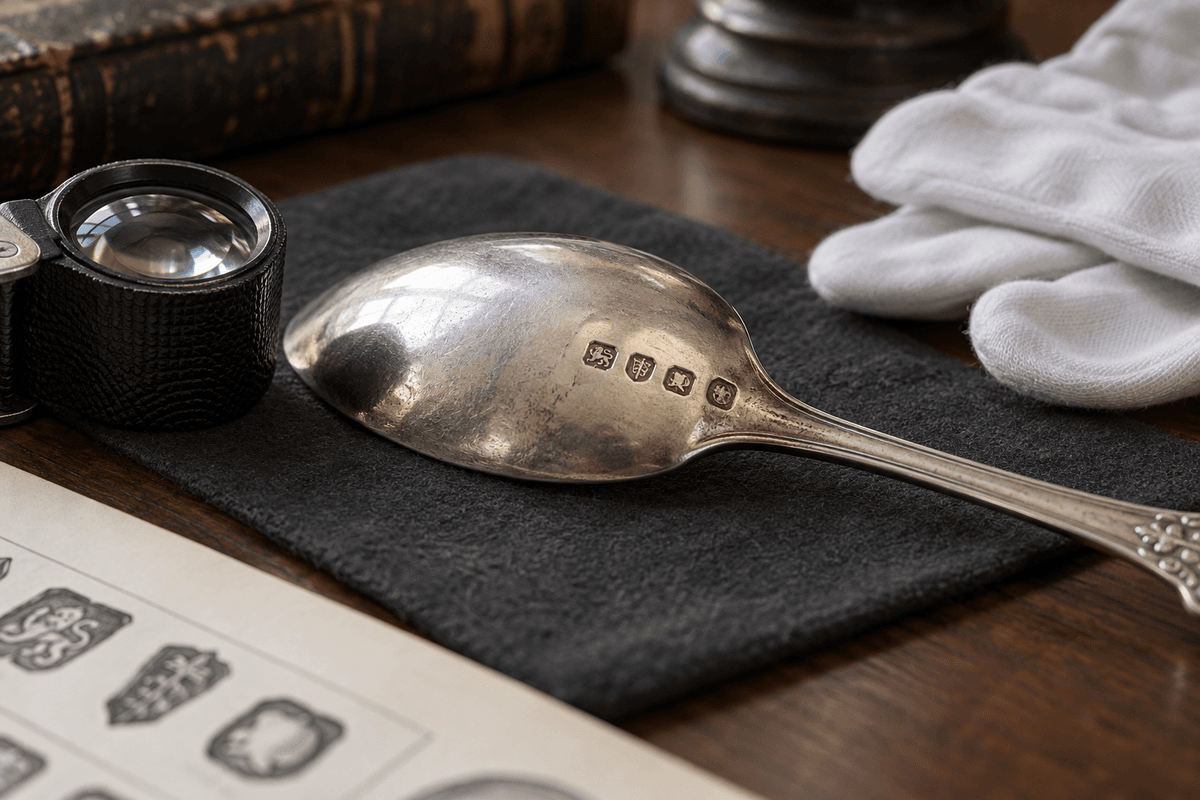
Which silver marks should be read together?
Read sponsor or maker wording, fineness, assay-office symbol and optional date letter as a group. Do not crop away shield shapes or neighboring punches.
How should silver marks be photographed?
Photograph the entire object first, then the complete mark group, then a sharp close-up from a second light angle. Record dimensions separately. Preserve the original file; do not polish, scrape or retouch a mark to make it easier to read.
| Evidence | What to record | Research limit |
|---|---|---|
| Wording or mark | Research meaning | Check next |
| 925 / Sterling | 925 parts silver per thousand in U.S. guidance | Responsibility mark and object context |
| Coin silver | At least 900 parts silver per thousand in U.S. guidance | Maker, construction and testing |
| EPNS / silver plate | A silver surface over base metal | Base metal exposure and maker |
Is 925 the same as a full British hallmark?
No. 925 is a fineness statement. A full UK hallmark also carries a sponsor mark and assay-office mark; a date letter is optional.
What can a silver mark prove?
A photographed mark is evidence to research, not a certificate. A mark alone cannot prove authenticity, exact age, maker attribution, precious-metal content, condition or market value. Compare the complete object with documented records and obtain an in-person test when the decision depends on material or authenticity.
How should silver objects be compared?
Compare the same object type, dimensions, maker evidence and condition. Keep solid silver, coin silver and plated objects in separate groups.
Primary references
- British Hallmarking Council: Hallmarking practical guidance
- U.S. Federal Trade Commission: Buying platinum, gold, and silver jewelry
- The Metropolitan Museum of Art: Nineteenth-century English silver
References support the stated systems and documented examples. They do not endorse CuriSnap or authenticate a reader’s object.
Frequently asked questions
Can silver marks identification authenticate an object?
No. A photograph and reference comparison can narrow a research question, but authentication and material testing require appropriate examination of the object.
What photograph should I take first?
Take one sharp photograph of the entire object, followed by the complete mark group and a close-up from a second light angle.