CuriSnap marks and hallmarks field guide
Furniture labels, stamps and construction marks: an identification record
Furniture identification should combine labels and stamps with dimensions, construction, hardware, timber observations, repairs and provenance. A label can name a retailer, manufacturer or owner; it does not automatically date the entire piece or prove that every component is original.
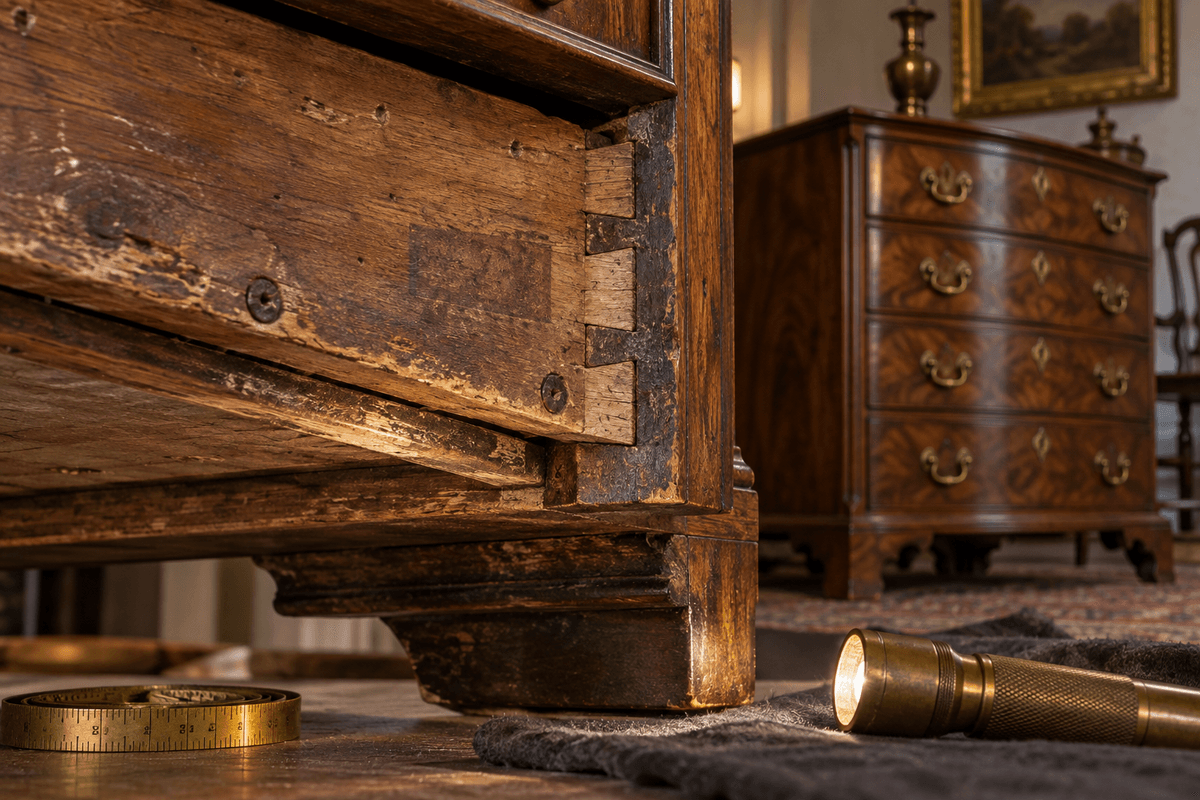
Where are furniture marks commonly found?
Check accessible drawer backs and bottoms, case backs, undersides and hardware without dismantling the piece. Stop if moving or opening it risks damage.
How should furniture marks be photographed?
Photograph the entire object first, then the complete mark group, then a sharp close-up from a second light angle. Record dimensions separately. Preserve the original file; do not polish, scrape or retouch a mark to make it easier to read.
| Evidence | What to record | Research limit |
|---|---|---|
| Evidence | Record | Do not assume |
| Paper label | Wording, border, position and wear | Original maker |
| Branded or stamped mark | Complete characters and location | Date of all components |
| Joinery | Drawer and frame construction | Authenticity from one joint |
| Hardware | Fasteners, holes and wear | Originality without comparison |
How can replacement parts change the reading?
A marked lock, handle or drawer may be later than the carcase. Record attachment holes, mismatched wear and each component separately.
What can a furniture label prove?
A photographed mark is evidence to research, not a certificate. A mark alone cannot prove authenticity, exact age, maker attribution, precious-metal content, condition or market value. Compare the complete object with documented records and obtain an in-person test when the decision depends on material or authenticity.
How should a catalogue comparison be made?
Compare dimensions, profile, joinery, hardware, materials and provenance. Decorative style alone is not enough for a maker attribution.
Primary references
References support the stated systems and documented examples. They do not endorse CuriSnap or authenticate a reader’s object.
Frequently asked questions
Can furniture labels, stamps and construction marks authenticate an object?
No. A photograph and reference comparison can narrow a research question, but authentication and material testing require appropriate examination of the object.
What photograph should I take first?
Take one sharp photograph of the entire object, followed by the complete mark group and a close-up from a second light angle.