 CuriSnap
A UK hallmark requires a sponsor’s mark, fineness mark and assay office mark. A lone “925” does not establish that the item received an official UK assay-office hallmark.
CuriSnap · PHOTO RESEARCH
Beyond one number.Read the complete metal mark.
Compare whole objects, engravings and historical English silver marks to separate decoration, fineness and assay information.
REAL REFERENCE PHOTOGRAPHComplete groups of English silver marks
Engraving, fineness and assay marks are different clues
Start with the whole object, then the complete mark group. Decorative initials, ownership inscriptions and assay marks serve different purposes; not every letter is a brand or a silver standard.
Silver teapot: start with the whole object
The whole-object view shows the body, handle, spout and lid. Use it to establish the object and its construction before allowing a single symbol to stand for the entire piece.
The Metropolitan Museum of Art · 28.88.3 · Public DomainAnother view of the same teapot
Another view emphasizes the engraved initials and decoration. It documents lettering, not a clear official fineness hallmark close-up. Decorative initials do not provide a purity measurement.
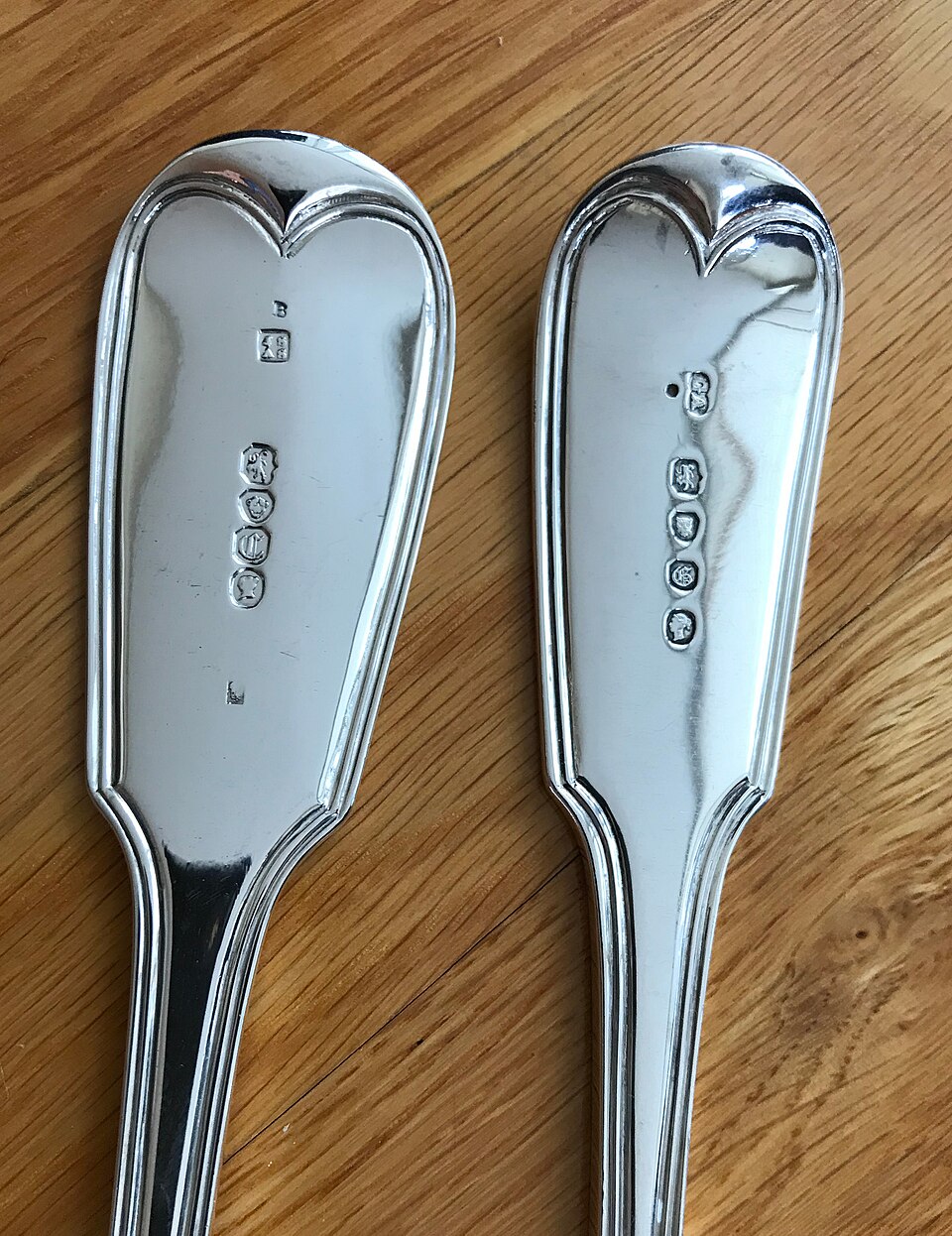
The Metropolitan Museum of Art · 28.88.3 · Public DomainComplete groups of English silver marks
This photograph retains adjacent initials, symbols and surrounding shapes. Research them together with country, assay office and period. These historical examples are not a universal template for all jewelry.
Grenadille · Wikimedia Commons · CC BY-SA 4.0 · LicenseRecord four fields, not just one number
Sponsor
A clue to who submitted the item; not necessarily its maker.
Fineness
925 and 750 express parts-per-thousand fineness; a number alone does not establish official assay.
Assay office
Research the testing office, not automatically the manufacturing location.
Date letter
Check the system and surrounding shape; date letters are not mandatory in every system.
UK hallmark reference ↗A price tag is not the total you pay
Separate the sale price, buyer’s premium and shipping. Change the hypothetical numbers below. This is arithmetic, not an auction quote or object valuation.
Formula: hammer price × (1 + premium rate) + shipping. Tax, insurance and payment fees are excluded. Actual transactions follow the relevant seller’s terms.
What does a lone “750” directly indicate?
What can common marks tell you?
| Visible clue | Supports | Does not establish | Next check |
|---|---|---|---|
| 925 | A silver standard of 925 parts per thousand | Brand, production date or gem quality | Check the complete mark group and construction |
| 750 | A gold standard of 750 parts per thousand, or 18ct | Natural gems or the whole item’s price | Check assay marks and gem documentation |
| Sponsor’s initials | Who submitted the item for hallmarking | Who physically made the jewelry | Compare letters, surrounding shape and register |
| Date letter | A clue to the year the hallmark was applied | Necessarily the design or manufacture year | Check office, letter style and surrounding shape |
WORKED SCENARIO · NOT A VALUATION
A ring says “750”. What is still missing?
Do not jump from fineness to brand and price. Photograph the adjacent letters and symbols, then the whole ring, setting and back. Unknown gem identity, treatment and weight prevent a direct comparison with a branded gemstone ring.
Use this checklist
- Capture the numbers, initials and surrounding shapes together.
- Record total weight; do not treat it as pure gold weight.
- For gems or substantial transactions, obtain testing documentation and physical checks.
Why does a metal mark not price the whole piece?
Metal content, gemstone documentation, brand attribution, craftsmanship, condition and selling channel need separate checks. A fineness number answers only part of the question. UK rules do not automatically apply to every country or historical period.
Fineness, UK mark components, sponsor marks and date letters follow Birmingham Assay Office guidance. This is mark-reading guidance, not a metal test of a photographed object. Birmingham Assay Office · UK Hallmarks
Does an assay-office mark establish where it was made?
Not necessarily. A UK assay-office mark identifies where the item was tested and hallmarked, not necessarily where it was manufactured.
Which photos should you take?
Capture the details before starting research.
Whole piece
Show the setting, clasp and connections.
Hallmark close-up
Capture all numbers, letters and symbols together.
Construction and wear
Record the back, wear and visible repairs.
Use these observation methods on your own object
Prepare whole-object, mark and detail photos, then open the live identification tool. Reports require sign-in and credits; photo research is not physical authentication or formal appraisal.
Start photo identification →