CuriSnap marks and hallmarks field guide
Porcelain marks and dating: why a matching reign mark is not enough
A porcelain mark can name a reign, factory, decorator or retailer without proving when the object was made. The Cleveland Museum of Art records a bowl made in the Kangxi period, 1662–1722, carrying a Chenghua reign mark. Date the complete object, not the wording alone.
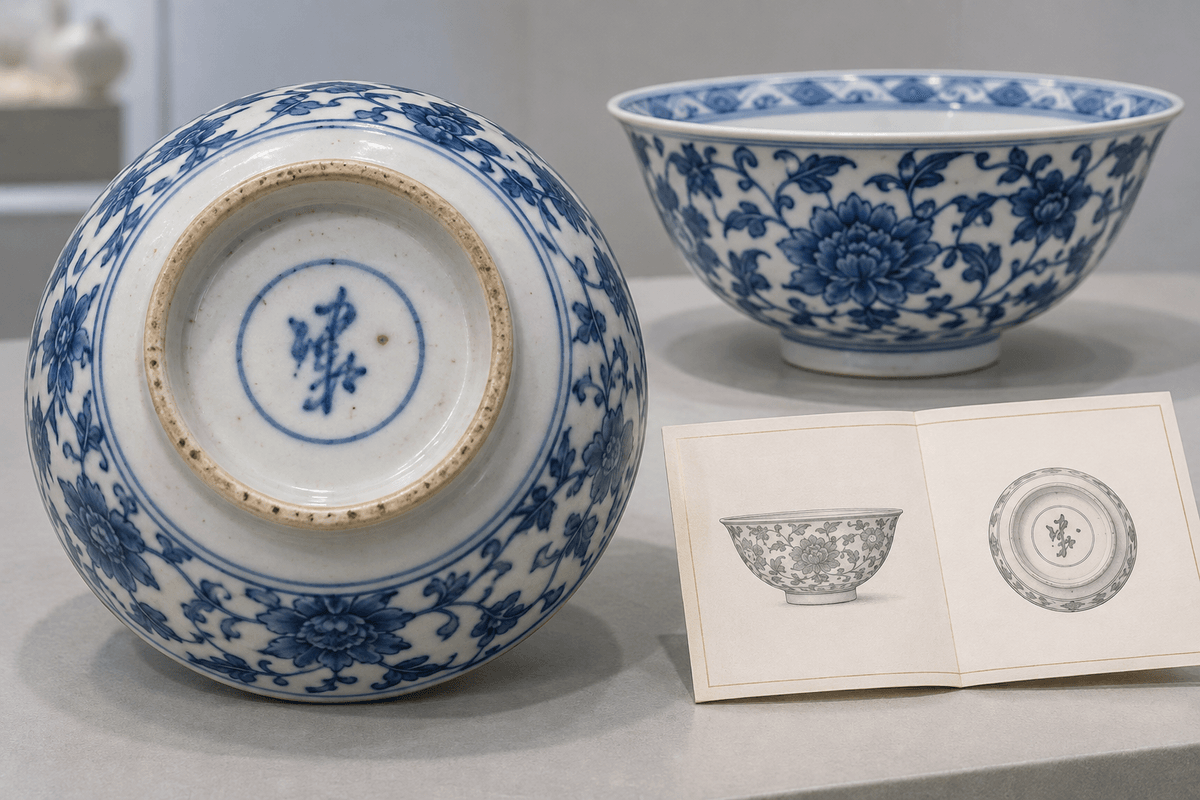
Why can a reign mark be later than the object it names?
Reign marks can be commemorative or referential. The mark’s wording must be compared with the body, form, painting and documented parallels.
How should porcelain marks be photographed?
Photograph the entire object first, then the complete mark group, then a sharp close-up from a second light angle. Record dimensions separately. Preserve the original file; do not polish, scrape or retouch a mark to make it easier to read.
| Evidence | What to record | Research limit |
|---|---|---|
| Evidence | What to record | Do not convert into |
| Mark transcription | Characters in original order | Automatic production date |
| Body and foot | Color, texture, glaze boundary | Factory from one feature |
| Museum record | Accession, date wording, medium | Proof of identical origin |
| Condition | Repairs, wear and losses | Artificial age claim |
What should a museum comparison include?
Record accession number, catalogue date wording, dimensions, medium, provenance and the exact reason the record is comparable.
What can a porcelain mark prove?
A photographed mark is evidence to research, not a certificate. A mark alone cannot prove authenticity, exact age, maker attribution, precious-metal content, condition or market value. Compare the complete object with documented records and obtain an in-person test when the decision depends on material or authenticity.
How should uncertainty be written?
Use “mark reads…”, “museum comparison suggests…” and “date unresolved” as separate statements. Do not collapse them into a precise year.
Primary references
- Cleveland Museum of Art: Bowl with Xiwangmu and Attendants, 1964.218.1
- The Metropolitan Museum of Art: Sèvres porcelain makers and marks
References support the stated systems and documented examples. They do not endorse CuriSnap or authenticate a reader’s object.
Frequently asked questions
Can porcelain marks and dating authenticate an object?
No. A photograph and reference comparison can narrow a research question, but authentication and material testing require appropriate examination of the object.
What photograph should I take first?
Take one sharp photograph of the entire object, followed by the complete mark group and a close-up from a second light angle.