Antiques / Silverware / Mark Research
EPNS, 925, and British Silver Hallmarks: How to Distinguish Sterling Silver from Silver Plate
First, read the complete set of markings, then examine wear locations, object structure, and weight records. EPNS typically refers to electroplated nickel silver; 925 represents a fineness of 925 parts per thousand. However, a single number, color, or magnetic reaction cannot independently prove that the entire object is sterling silver.
This handbook addresses a specific problem: how to separately record "looks like silver," "what the mark says," and "whether it has been legally assayed" when encountering a silver-colored item. British hallmarks are used as verifiable examples and should not be applied to all countries and eras.
01 / First, look at the complete mark
What do EPNS, 925, and Sterling each mean?
EPNS is an abbreviation for Electro Plated Nickel Silver, indicating silver electroplated onto a nickel silver base; the name "nickel silver" does not mean the alloy contains silver. 925 is a fineness number in parts per thousand, indicating that the relevant fineness standard is at least 925 parts silver per 1000. Sterling is a common description for sterling silver, but marking systems, eras, and exemptions vary across different markets, so it is still necessary to check the rules of origin and the combination of marks.
| Mark Seen | Usually indicates | Cannot independently prove |
|---|---|---|
| EPNS | Electroplated silver layer covering a nickel silver base | Cannot prove the object is solid silver |
| EPBM | Electroplated silver layer covering a Britannia metal base | Cannot prove British legal fineness |
| 925 | Silver fineness number of 925 parts per thousand | An isolated number cannot prove the mark is genuine, complete, or applies to the entire object |
| A1, AI | Commonly found on silver-plated items as a grade or commercial mark | Not a British legal sterling silver fineness number |
| Graphic, letter, trademark | Could be a manufacturer, sponsor, assay office, date, or trademark | Cannot determine city, year, or metal solely by appearance without verification |
The UK government's practical guidance states that a complete contemporary British legal hallmark comprises three mandatory components: sponsor's or maker's mark, metal and fineness mark, and assay office mark; the date letter is now optional. Source: British Hallmarking Council / GOV.UK. Historical items, items below the exemption weight, and other jurisdictions may differ.
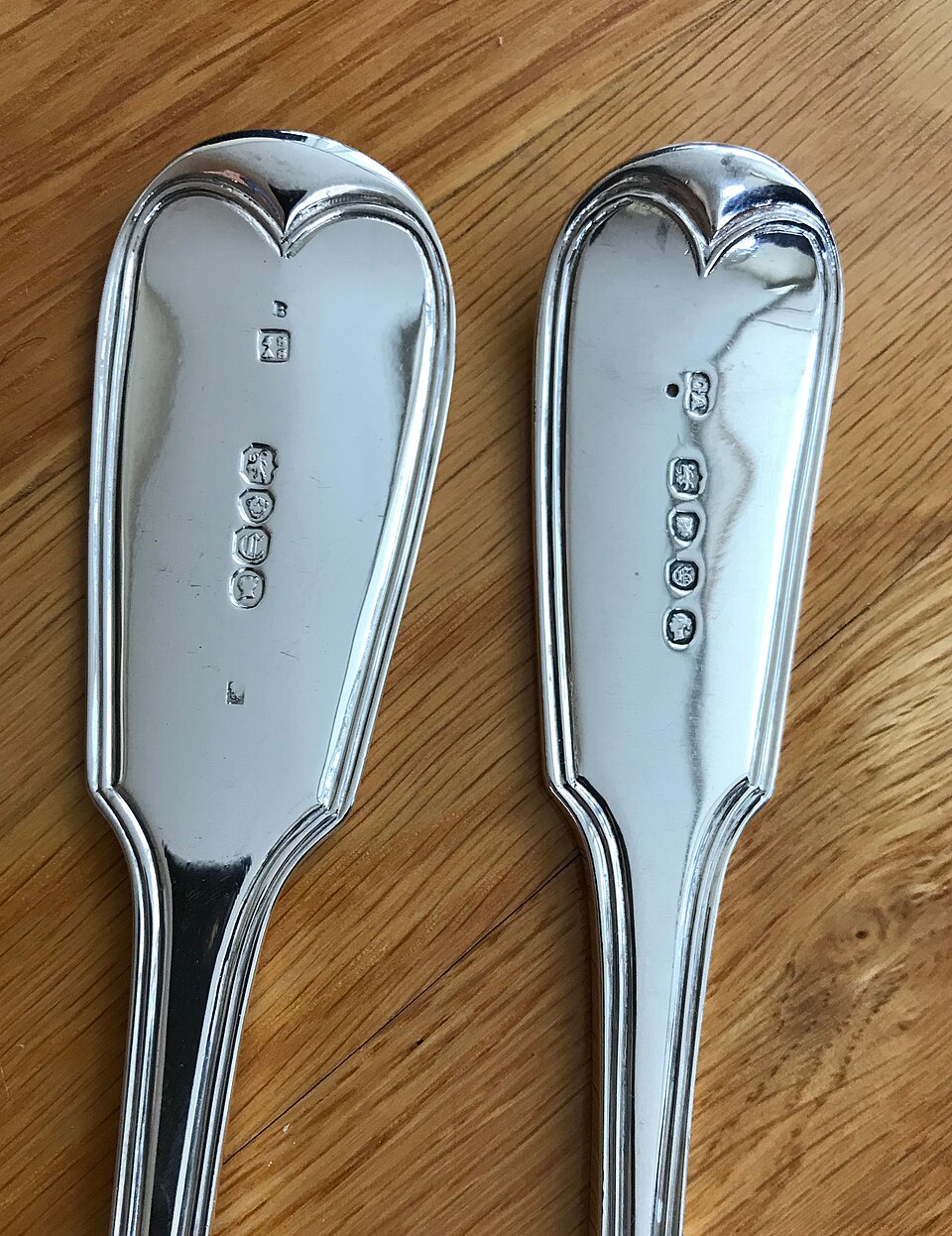
_silver_hallmarks_(with_Tally_Mark).jpg)
02 / Order of Assessment
How to reach a provisional conclusion of "sterling silver or silver plate" from the markings?
- Photograph the entire item: Record the front, back, bottom, dimensions, and weight. Handles, lids, blades, and fittings may use different materials.
- Photograph the complete set of marks: First preserve their relative positions, then add macro shots. Transcribe legible characters, and write question marks for unclear areas.
- Prioritize commercial plating terms: EPNS, EPBM, A1, etc., should be listed separately and not reinterpreted as "sterling silver hallmarks."
- Verify the system: Confirm the country or city claimed by the mark, the applicable era, mandatory components, and fineness standards. The three mandatory components of a contemporary British complete hallmark cannot be replaced by a single 925 number.
- Examine wear and structure: If high-contact edges reveal a different colored base metal, it supports the possibility of plating wear; solder joints, fittings, and liners should also be checked separately.
- For high-value transactions, get it tested: Have it examined by a qualified testing institution or silver expert. Acid tests, filing, and scratching can cause permanent damage and should not be performed without the owner's permission.
03 / Don't be swayed by a single test
If a magnet doesn't stick and the surface is black, does that prove it's sterling silver?
No. Many non-ferrous metals are also not noticeably attracted by ordinary magnets; silver-plated surfaces can also show oxidation and sulfidation discoloration of silver. Magnets and discoloration can only be recorded as observations and cannot replace fineness mark verification or material testing.
- Exposed copper-colored or yellowish-gray base: This could be plating wear, or it could come from solder, repairs, or composite materials; the specific location needs to be recorded.
- Uniform color throughout: This does not rule out re-plating, nor does it prove the internal material.
- Very heavy weight: This could be due to thick walls, filler, or another base material; weight should be compared with size, structure, and similar objects.
- Only a single 925: First, check the font, method of impression, location, and other marks. Modern fake marks and misuses do not disappear just because the number is correct.
04 / Pre-Purchase Questions
When a seller writes "antique silver," what should you ask about?
First, ask the seller to clarify whether "silver" means solid silver, silver-plated, or merely silver-colored in appearance. Then, request photos of the complete set of marks, the item's weight, dimensions, bottom, and high-wear areas, and ask if it has been re-plated, repaired with solder, filled, or had parts replaced. Record the answers in the transaction log.
Questions you can copy directly to the seller
Please confirm whether this item is solid silver or silver-plated, and provide clear photos of the entire bottom, all marks, weight, and dimensions. Has it been re-plated, repaired with solder, filled, is it missing parts, or have the handle/finial been replaced? If claimed to have British legal hallmarks, please specify where the sponsor's mark, fineness mark, and assay office mark are located.
The legal exemption weight for silver items listed in British guidance is 7.78 grams, so "small items without complete hallmarks" does not automatically mean fake; nor does it automatically mean genuine. Whether an exemption applies depends on the place of sale, the item's age, actual weight, and description.
05 / Common Questions
What else is easily misunderstood about silver hallmarks?
Does EPNS have collectible value?
Possibly. Manufacturer, design, age, rarity, condition, and completeness can all influence collecting interest, but EPNS indicates silver plate and should not be valued based on solid silver content.
Is 925 always better than 800 silver?
925 indicates a higher silver fineness number, but an object's value is not solely determined by silver content. Authorship, craftsmanship, history, condition, and provenance can be more important than fineness differences.
Is the date letter the year of manufacture?
In the British system, the date letter indicates the year it was sent for assay and marking; under the current system, it is optional. An isolated letter cannot be directly converted to a year without considering the assay office, font cycle, and other marks.
Can household acid tests confirm it?
Acid tests require appropriate sampling locations and experience, can damage the surface, and plating may interfere with superficial tests. High-value or historically significant items should be tested by professionals.
Write down your silver assessment as a verifiable record
Record the original marks, photo locations, weight, system source, and provisional conclusion. For example: "EPNS and manufacturer's trademark seen on bottom, with discolored wear on edges; provisionally recorded as silver-plated, manufacturer and age to be investigated." Do not hide pending investigations in affirmative statements.
Compiled and edited by CuriSnap. Data verification date: 2026-09-11. British hallmarking rules adopt public guidance from British Hallmarking Council / GOV.UK; electroplating process background references V&A Metalworking Techniques Guide; EPNS, EPBM, and A1 definitions reference SilverCollection Mark Dictionary. This article provides a research sequence and does not constitute legal fineness certification or valuation.